TDCJ Release Destinations
A person enters TDCJ after the county-jail phase ends by custodial transfer. That transfer from Winkler County is not a community release, even though the person has left the local jail. TDCJ assigns the person within its statewide prison or state-jail system. No TDCJ unit was identified in Loving County, so a Loving conviction does not imply a local state prison.
Departure from a TDCJ unit may be parole, mandatory supervision, or flat discharge. Parole and mandatory supervision both allow physical departure while the sentence remains under state control. The TDCJ Parole Division supervises those cases. A flat discharge ends the sentence. A detainer or transfer can instead move the person into another agency's custody, so the release type and destination matter as much as the date.
TDCJ guidance says general facility releases occur on weekdays, excluding holidays, during its stated daytime window. Scheduled dates can change. The agency may provide civilian clothing and bus transport to a station near an approved residence, or family may arrange pickup at the releasing site. Those statewide rules do not describe a Winkler county-jail release.
Confirm a TDCJ Release
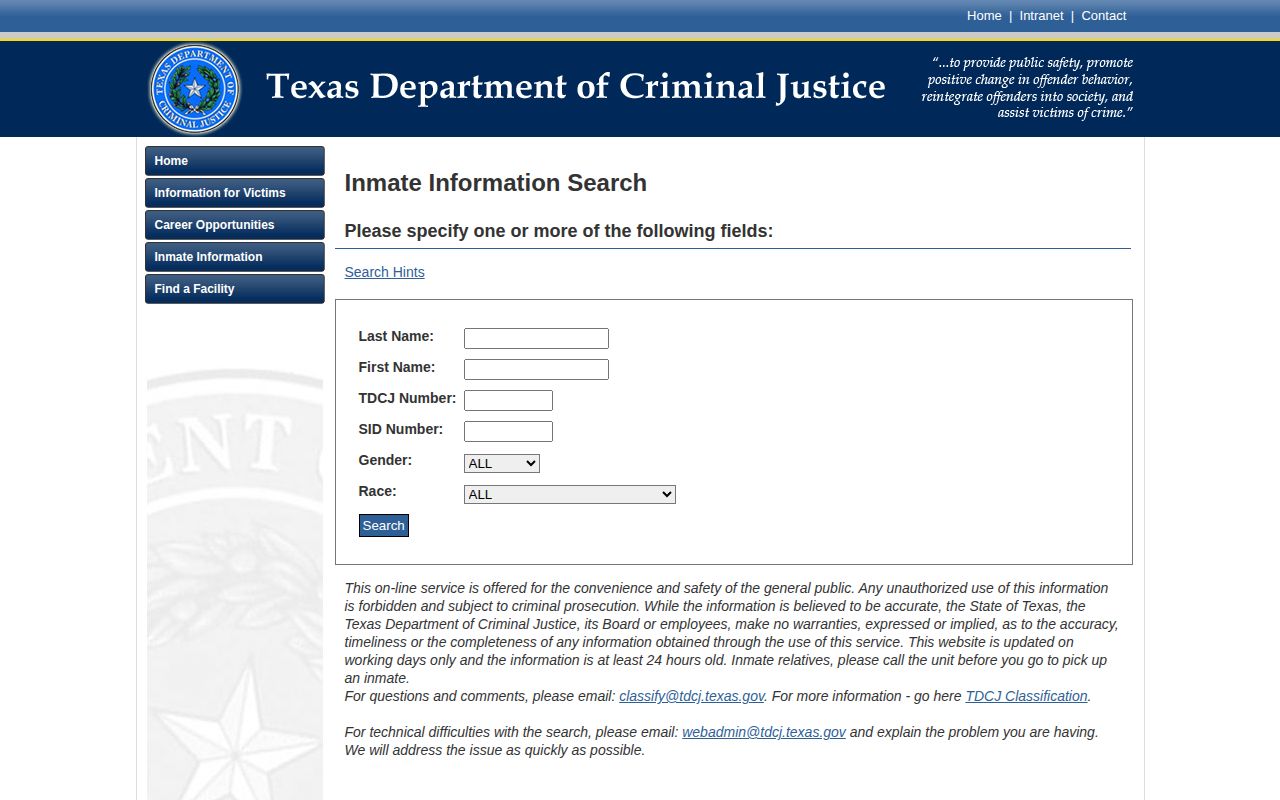
Start with the official TDCJ Offender Search. A seven-digit TDCJ number or SID gives the best identity match. Otherwise search by name, then compare birth information, age, offense, and conviction county. Open the detail record. A result-list snippet can hide the status fields needed to distinguish prison from supervision.
Read location and status together. A prison unit indicates incarceration. A parole-office or supervision location, paired with an actual release date, can show that the person left prison but remains supervised. Preserve the identifier and release type. If the record links parole-review information, treat eligibility, review, and a Board vote as separate steps. Approval can carry conditions and is not proof that release processing finished.
If a person cannot be found, confirm the name and identifier. A Loving arrestee who never received a TDCJ sentence should not appear merely because Winkler held the person. Conversely, someone fully discharged may have less detail in the live view. Use the free information email or a Public Information Act request for archival confirmation. The Loving County release search paths explain when Winkler, court, TDCJ, or federal records control.
TDCJ Release Record Requests
TDCJ's basic inmate-information channel is unusually useful. Email pia@tdcj.texas.gov with the full name and TDCJ number. If the number is unknown, provide the exact birth date or approximate age plus conviction county. Request the TDCJ number, incarceration history, offense, county and court, last location, Projected Release Date, actual release date, and supervision or discharge status. TDCJ identifies this listed information service as free and excludes photographs and Social Security numbers.
For a formal document, use the TDCJ Public Information Act route. Ask for the actual release date, release type, discharge date, unit released from, release certificate, and supervision status. Confidential information may be withheld. The release certificate is strong evidence for parole or mandatory supervision because TDCJ reviews its rules with the releasee and provides a copy at release.
Classification and time questions can go to 936-437-6231 or classify@tdcj.texas.gov. Review and Release Processing lists 512-406-5449 and 8610 Shoal Creek Boulevard, Austin, Texas 78757. The Parole Division lists 512-406-5401. These offices answer different parts of the record; a county clerk cannot certify a TDCJ release.
Loving Cases Enter TDCJ
The state system holds people serving qualifying felony and state-jail sentences. The Loving County and District Clerk provides the local court path that establishes the sentence, while TDCJ administers time and release. The Winkler Sheriff transfer record proves the local phase ended. The TDCJ record then controls unit assignment and state supervision.
Do not call TDCJ a Loving County jail. The physical state unit may be far from Mentone. A Loving court case can explain the conviction and sentence, but the court docket does not certify the exact instant TDCJ completed release. Match the judgment and cause number to the TDCJ identity and later actual-release record.
TDCJ Projected Versus Actual Release
The exact future field is Projected Release Date. TDCJ defines it as the date calculated by Classification and Records when release is projected if parole does not occur sooner. The formula varies with offense and offense date. For some older mandatory-supervision-eligible offenses, flat time plus good time affects the calculation. Later qualifying cases can involve discretionary mandatory-supervision review.
A projection is not a promise. Discipline, time-credit changes, sentence corrections, consecutive cases, detainers, required programs, Board action, and record audits can move it. TDCJ guidance indicates that an audit and scheduled-release calculation after receipt of a release certificate can take time, and even a scheduled date remains subject to change. The Release Date Lookup page explains these distinctions.
Texas has no general rule that every person serves one fixed percentage. Government Code Chapters 498 and 508 make eligibility offense- and date-specific. Good-conduct time can affect eligibility but does not itself shorten the sentence. For historical proof, use the actual release date and status, not arithmetic performed from the sentence length.
TDCJ Parole Release Status
The Texas Board of Pardons and Paroles decides parole and discretionary mandatory supervision. The TDCJ Parole Division supervises a person after release. A Board vote answers whether release was approved or denied under stated conditions; it does not establish the day the person left a unit. Review and Release Processing still checks residence plans, county requirements, discipline, special conditions, and programs.
An actual release date plus a parole-office location is stronger evidence of departure. Nearby Region V offices include Monahans and Odessa, but the researched directory did not conclusively assign Loving County to either. Call before assuming an office. For review status, the Board line is 844-512-0461. Post-release rules and office routing are covered at Post-Release Supervision.
Probation is different. Texas calls it community supervision, and it comes through the sentencing court and a Community Supervision and Corrections Department rather than TDCJ parole. The state locator groups Loving, Reeves, and Ward through Reeves County CSCD. A bond release is neither parole nor probation unless a court separately orders supervision.
Open the official TDCJ Offender Search before interpreting a state release.