
Loving County Release Date Types
A projected release date is TDCJ’s current calculation of a possible future release point under the governing sentence, eligibility rules, credits, Board action, and record data. It is not a promise. A scheduled date is closer to an operational plan but can still depend on audit, release-plan approval, detainers, and transport. An actual release date records that departure occurred. For someone on parole, that date ends prison custody but not the sentence or supervision.
A person awaiting trial usually has no calculated TDCJ date. Bond, dismissal, plea, sentencing, another hold, or a court order can change county custody. Winkler County’s exact time record proves the physical jail event, while the Loving court cause explains its legal basis.
Find Loving County Release Dates
Choose the source from the sentence and custodian. Loving County does not operate an open jail, so the routine county-jail record is created by Winkler County in Kermit.
- Identify whether the person is pretrial, serving a county sentence, in TDCJ, or held by another authority.
- For Winkler custody, call 432-586-3461 and request the authorized release order, exact date and time, reason, and destination.
- Check the Loving County court cause for bond, jail credit, dismissal, judgment, sentence, capias, or transfer orders.
- For state custody, search the TDCJ Offender Search by name, seven-digit TDCJ number, or SID.
- Read Projected Release Date beside parole eligibility, review details, status, and any actual release or parole office field.
- Use VINE Inmate Check for event notifications, then verify the alert with the source record.
A BOP date applies only to federal BOP custody. ICE and USMS use different systems. A transfer date between agencies is not necessarily a return to the community.
Loving County TDCJ Date Fields
TDCJ search results may include identity, age, location or unit, offense, county and court, sentence, parole review information, Projected Release Date, and scheduled or actual release data. The free TDCJ inmate-information email can provide listed basic facts, including the Projected Release Date, but not photographs or Social Security numbers.
| Field | Meaning | How to use it |
|---|---|---|
| Projected Release Date | TDCJ’s current calculated future date | Recheck after Board or record changes. |
| Parole eligibility or review | When review may occur and its status | Do not treat eligibility as approval. |
| Scheduled release | A planned event after processing | Ask whether audit and release plans are complete. |
| Actual release date | Recorded departure from TDCJ custody | Read with status and parole office. |
| Maximum expiration | Sentence endpoint calculated by TDCJ | It may differ from parole or supervision eligibility. |
The official definition page is the clearest source for the date field.
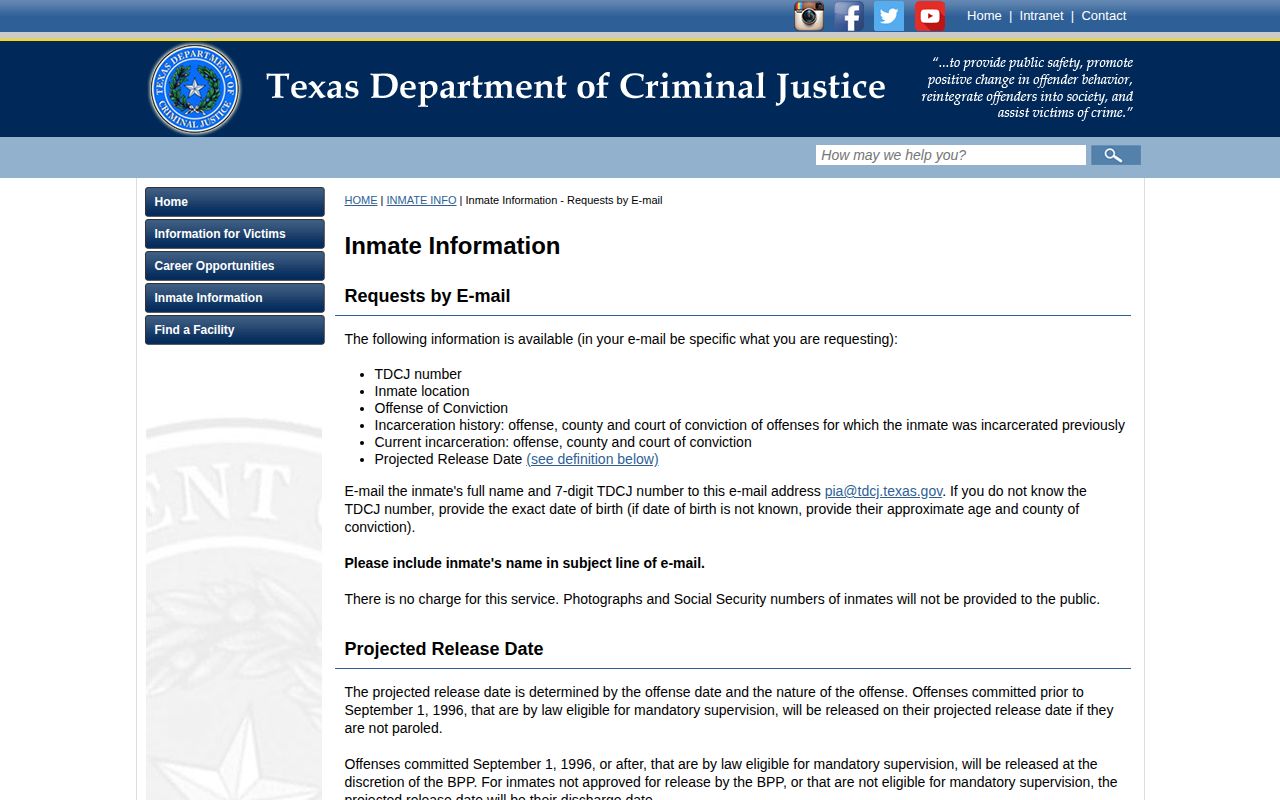
The field is a calculation maintained by TDCJ, so personal arithmetic should not replace it.
No Texas Eighty-Five Percent Rule
Texas has no general rule requiring every person to serve 85 percent of a sentence. Applying the federal concept or another state’s formula to a Loving County case can produce a false date. Texas calculations depend on offense date, offense, sentence structure, statutory eligibility, good-conduct time, mandatory-supervision exclusions, and Board decisions.
Government Code §498.003 makes good-conduct time a privilege. It can affect eligibility for parole or mandatory supervision, but it does not otherwise reduce the sentence itself. Misconduct, forfeiture, restoration, classification, and qualifying participation can affect credit. No one should promise a date by subtracting accumulated credit from the sentence.
Government Code Chapter 508 contains the controlling parole and mandatory-supervision provisions. Section 508.145 has multiple parole formulas. Section 508.147 describes the calendar-time-plus-good-time framework, while §508.149 lists exclusions. The current statute must be matched to the offense and date.
Loving County Date Calculation Factors
TDCJ Classification and Records performs the authoritative state computation. Several changes can alter the public date without any error in the search portal.
| Factor | Possible effect |
|---|---|
| Offense and offense date | Select the statute and eligibility formula that apply. |
| Sentence and consecutive cases | Change the term TDCJ must administer. |
| Good-conduct classification | Can change parole or mandatory-supervision eligibility credit. |
| Board approval or denial | Can set conditions, a later month, another review, or maximum expiration. |
| Record or court correction | May cause TDCJ to recompute jail credit or sentence data. |
| Detainer or receiving authority | May turn TDCJ departure into another custodial transfer. |
| Release-plan audit | Can delay the physical event even after favorable action. |
A favorable parole vote is not physical release. TDCJ must complete required processing, and approval may be withdrawn if new information arises. Confirm later through an actual release date and supervision status.
Loving County Jail Date Records
TDCJ good-time rules do not calculate a Winkler county-jail release. For a county sentence, Texas jail standard §267.6 supplies the researched timing rule. Sentence discharge ordinarily occurs between 6:00 a.m. and 5:00 p.m. Up to 18 hours can be credited so release occurs in that period on the preceding day. Bond and listed warrant, transfer, or admission circumstances can allow after-hours action.
That statewide rule is not a Winkler promise. Ask the court for the judgment and jail-credit language. Ask Winkler for the release order and exact time. A pretrial person may remain held because bond has not been posted or another detainer exists, so a theoretical calculation cannot establish an exit.
Can the court docket prove the exact time? No. It may explain the order, sentence, or bond event, but Winkler’s completed release entry records when the jail acted.
Loving County Parole Date Meaning
Initial parole eligibility is not the same as release. TDCJ may identify a case for Board processing months before review. The Board examines the file, and approval codes may call for release when eligible, a later month, or completion of a program. Denial may set another review or require more time.
Mandatory supervision also varies by offense date and exclusions. For some older eligible offenses, TDCJ describes a qualifying projected point if parole has not occurred. For qualifying later offenses, release can require discretionary Board approval. A denial may move the displayed projection to maximum expiration until later approval or recalculation.
Once released on parole or mandatory supervision, the actual release date plus a parole-office entry is stronger proof than a prior projection. The Post-Release Supervision page separates parole from probation and gives the official verification channels.
Loving County Date Record Requests
For state records, TDCJ offers a free basic-information email route and a formal Public Information Act process for release certificates or discharge documentation. Classification and time questions can be directed to 936-437-6231 or classify@tdcj.texas.gov. Review & Release Processing lists 512-406-5449.
For the county phase, send separate requests. Loving County can provide arrest-side records, warrant or cause identifiers, and material it maintains. Winkler County should receive the request for booking, release order, exact time, release type, bond entry, and destination. The broader Loving County released inmate lookup explains how those records fit with courts and transfers.
Loving County Date Verification
Several records may display dates for different events. A court order may authorize release before staff complete identity, property, warrant, and hold checks. TDCJ eligibility marks when review can occur, while a projected date reflects the current calculation. Only the completed release entry establishes departure from that custodian.
When dates conflict, ask each office for its source document. A Winkler error belongs with Winkler’s release-order and time record. An arrest-origin error belongs with Loving County. A sentence or jail-credit error belongs with the clerk and court. A TDCJ calculation question belongs with Classification and Records.
Transfers require care. A person can leave Winkler for TDCJ, another county, USMS, or ICE. A TDCJ departure can also lead to another detainer. Record the destination before describing a date as community release. Recheck time-sensitive results because sentence audits can change displayed data.
No researched source supplied a fixed local fee or guaranteed turnaround. Request electronic copies, give a narrow name and date range, and ask for an estimate before costs exceed $25.
Compare the public field with the latest parole review result. A denial can set a later review, while approval may require a program or future month. Even after favorable action, release-plan review and a detainer can affect where and when the person leaves. Final status, actual date, and receiving authority provide the soundest confirmation.
Keep a dated copy of each result used in the comparison. A later TDCJ update can then be matched to the earlier projection and the completed release record.