BOP Release Destinations
The Federal Bureau of Prisons holds people serving federal sentences after commitment and designation. The U.S. Marshals Service normally controls the earlier federal arrest, pretrial detention, transport, and delivery phase. A person may be housed in a local or contract bed before reaching a BOP institution. Leaving Winkler for federal authority is thus a transfer, not proof of return to the community.
A BOP locator result may state “Released” or “Not in BOP Custody” and show a release date. That establishes departure from BOP custody only. The person may be under federal supervised release, held on another sovereign's warrant, transferred to immigration custody, or otherwise outside BOP. Check the sentencing docket and receiving authority when the destination is important.
No BOP institution was identified in Loving County. Search nationwide and do not infer a release location from the original county. A Loving arrest record, a federal docket, a USMS transport record, and a BOP record describe separate steps. The agency holding the person at each step is the one whose departure record matters.
Confirm a BOP Release
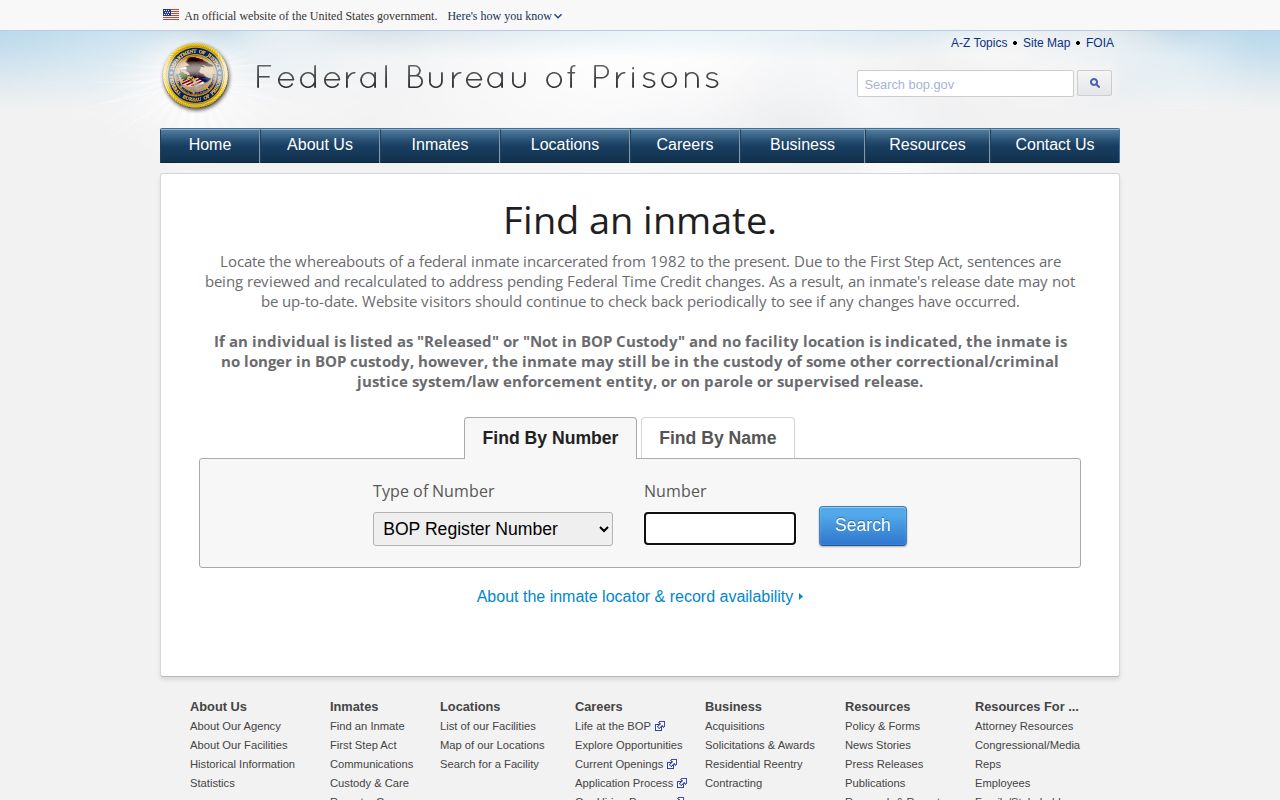
Use the official BOP Inmate Locator. Search by BOP register number when available. It commonly follows a five-digit, hyphen, three-digit form. The locator also accepts DCDC, FBI, or INS identifiers. A name search can be narrowed with optional age, race, and sex fields. Compare the full record rather than relying on a shared name.
Results can show name, register number, age, race, sex, release date, and location. Read date and location together. “Released” or “Not in BOP Custody” means the person is no longer confined by BOP, but it does not resolve supervision or another agency's custody. BOP also warns that sentence recalculations can affect displayed dates. Recheck time-sensitive information and preserve the register number.
If the person is missing, verify spelling and identifiers. Public locator coverage is described from 1982 to the present, which is a scope boundary rather than a promise that every fact is displayed. A recent federal detainee may still be controlled by USMS and not yet designated. Someone in ICE civil custody belongs in the ICE locator. A Loving or Winkler county detainee with no federal case should not be expected in BOP.
BOP Release Record Requests
When the locator is insufficient, use the BOP Freedom of Information Act page. A request should reasonably describe the person and record. Ask for the release date, release type, institution released from, transfer destination if disclosable, sentence computation or discharge information, and records that confirm departure. Supply the register number and date range whenever possible.
BOP lists BOP-OGC-EFOIA-S@BOP.GOV and FOIA/PA Section, Office of General Counsel, Room 924, Federal Bureau of Prisons, 320 First Street NW, Washington, DC 20534. Its public line is 202-616-7750. BOP states there is no initial fee, provides customary allowances for noncommercial requesters, and gives notice when estimated charges exceed $25. That policy does not mean every request is free.
Identity verification is required for one's own nonpublic records. Third-party details may be withheld under privacy and law-enforcement exemptions. Ask for segregable, nonexempt portions rather than assuming the entire file is public. If the question concerns pretrial custody or transport before BOP designation, direct the request to USMS instead. Federal court documents belong in the sentencing docket.
BOP Versus Loving Custody
BOP is a national federal prison system for sentenced people. It is not the local jail for Loving County. The Loving Sheriff jail page routes routine jail inquiries to the Winkler County Sheriff in Kermit. Winkler records the local booking, exact departure time, and transfer destination. The Loving County and District Clerk supplies the local court path.
A federal prosecution can begin with an arrest by federal or local officers, a detention hearing, and custody under USMS. The federal court may release or remand the person. After a conviction and sentence, USMS can deliver the person to a designated BOP facility. Each change can remove a name from one system while custody continues in another.
The Loving County released-inmate guide starts with the custody system for that reason. Do not interpret a BOP miss as proof of county release. Likewise, a BOP release result cannot establish what happened in an unrelated Loving case. Match identity, case number, sentence, and dates across the responsible sources.
Federal Docket Release Proof
The federal docket is the best public source for a detention decision, release order, judgment, sentence, revocation, or commitment. A court order can explain the legal authority for release, but it may precede physical processing. Pair it with the BOP locator or agency record showing that custody actually ended. For pretrial matters, a USMS custody record may fill that gap.
Federal supervised release is not prison custody. It begins after imprisonment under conditions imposed by the sentencing court and monitored by U.S. Probation. A BOP “Released” status does not show that supervision ended. Review the judgment, docket, and applicable probation office for the supervised-release term and later court action.
A detainer is a request or authority affecting custody after the current agency's phase ends. When one appears, identify the requesting jurisdiction. BOP departure can lead directly to state, local, or immigration custody. Asking only whether BOP released the person can miss that continued chain.
Loving Federal Transfer Checks
Loving County lies in the Western District of Texas. Nearby USMS district locations include Midland and Pecos, although current contact numbers should be confirmed on the official courthouse-location page. USMS has no public released-detainee locator. The federal docket and a focused USMS records request are the better routes for a person who has not entered BOP.
Ask Winkler for the exact receiving authority when a Loving detainee leaves for a federal matter. Then search the federal case by full identity and docket number. If the sentence results in BOP commitment, use the register number in the BOP locator. This stepwise process prevents the false claim that a departure from Kermit was a community release.
ICE is separate. A county transfer to immigration authorities should be followed in the Online Detainee Locator and through the Detention Reporting and Information Line. A BOP “Not in Custody” entry does not rule out ICE, and an ICE miss is itself inconclusive.
Historical BOP Release Coverage
The locator's stated coverage begins in 1982. That makes it useful for many former federal prisoners, but it is not a complete release certificate or a guarantee that all historical context remains visible. Names, old identifiers, and sentence changes can complicate a search. Use FOIA and the court docket when a durable record is needed.
Keep the register number with any saved result. It separates people with similar names and helps BOP locate a request. Compare the displayed release date to the judgment and later docket entries. If dates conflict, request the computation or release document rather than choosing the most convenient source.
The federal search begins at the official BOP Inmate Locator.