
Loving County Parole Versus Probation
Texas parole follows a state-prison sentence. The Texas Board of Pardons and Paroles decides parole and discretionary mandatory supervision. The TDCJ Parole Division supervises an approved person while the sentence continues in the community. Probation is called community supervision in Texas law. A sentencing court imposes it, and a Community Supervision and Corrections Department, or CSCD, administers it. Deferred adjudication is a court form of supervision and should not be labeled a TDCJ release.
A person released on bond from Winkler County’s jail is not automatically on either form. Bond conditions come from the court while the criminal case remains pending. A later judgment may impose probation, a jail term, a prison sentence, or another result.
| Issue | Parole or mandatory supervision | Probation |
|---|---|---|
| Source | Release from a TDCJ sentence | Order of the sentencing court |
| Decision or oversight | Board of Pardons and Paroles and TDCJ Parole Division | Court and local CSCD |
| Best public check | TDCJ Offender Search and parole review detail | Court cause and Reeves County CSCD confirmation |
| End record | TDCJ release or discharge documentation | Court and CSCD completion record |
- Parole
- Conditional community release while a state-prison sentence continues.
- Mandatory supervision
- A supervised release form governed by eligibility rules and, in many cases, discretionary review.
- Probation
- A court-ordered community sentence administered by a CSCD.
- Absconder
- A supervision status alleging loss of contact or failure to report; it is not proof of a new conviction.
Verify Loving County Release Supervision
Start with the system tied to the sentence. Names alone can match more than one person, so compare the TDCJ number, SID, date of birth, offense, county, and court whenever those fields are available.
- Search the TDCJ Offender Search for a person who served a Texas prison or state-jail sentence.
- Look for an actual release date, current status, parole office, and parole-review information. A projected date is not proof that prison release occurred.
- For a vote or review question, call the Board status line at 844-512-0461 with the name, TDCJ-CID number, or birth date.
- For probation, locate the Loving court cause and confirm with the CSCD shown by the official state locator.
- If the live TDCJ entry no longer shows old supervision, request release or discharge records through TDCJ’s Public Information Act process.
A county jail record answers a different question. Winkler’s release order and exact time establish departure from county custody. They do not establish parole unless a TDCJ record supports that status.
Loving County Supervision Office Split
The TDCJ CJAD location directory groups Loving, Reeves, and Ward Counties through Reeves County CSCD. Probation questions should go to that department and the sentencing court. State parole uses the separate TDCJ district-office structure. This local split is important because sending a probation question to a parole office will not confirm the court’s supervision record.
Region V includes nearby Monahans and Odessa offices, but the researched directory did not assign all Loving County cases to either one. Call before visiting or treating geography as proof of assignment.
Monahans District Parole Office
401 South Allen Avenue
Monahans, TX 79756
432-943-7254
Odessa District Parole Office
701 McDonald Street
Odessa, TX 79761
432-550-0131
TDCJ Parole Division
512-406-5401
Confirm the assigned office before travel.
The official Region V directory shows the current office listings.
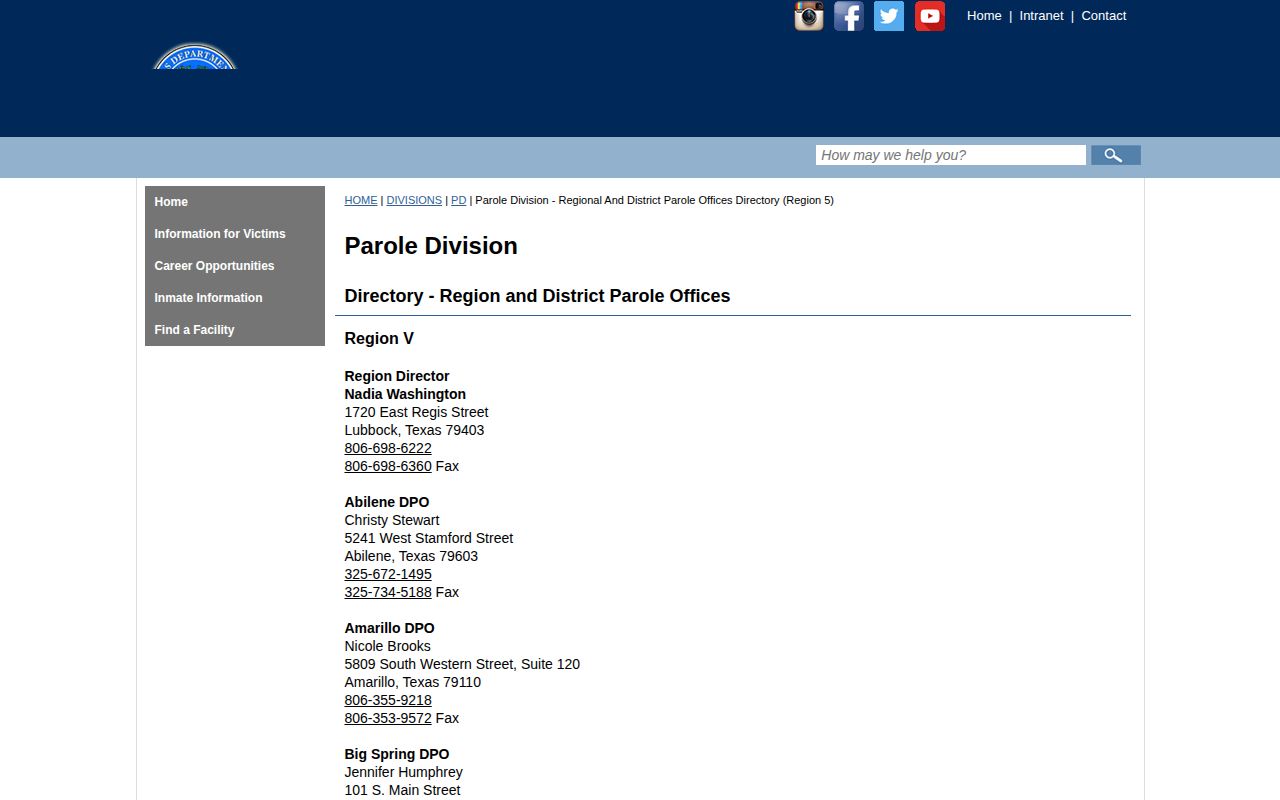
The directory supports office contact, but the person’s record or TDCJ should confirm the actual assignment.
Loving County Parole Review Process
Texas does not publish an ordinary public hearing calendar for routine parole consideration. The Board states that normal parole and mandatory-release reviews are not formal public hearings. Panel members review case files and vote separately. TDCJ identifies cases about six months before initial eligibility and about four months before later reviews. An Institutional Parole Officer interviews the person and prepares a summary. Three members vote in sequence, and two matching votes decide the result.
An FI-1 action generally indicates release when eligible. Other FI codes may require a future month or a program. RMS concerns mandatory supervision. A denial can set a new review date or require service of the sentence. Codes can change, and approval may be withdrawn after new information. Always use the current official vote definitions and later confirm the actual release date.
Loving County Supervision Warrants
TDCJ publishes a Parole Absconder Tip-Line at 866-680-6667. An absconder or warrant notation may signal an alleged violation and a return-to-custody process. It does not prove a new conviction, and it does not prove the person is presently booked in a particular jail. Verify the live TDCJ record, the warrant authority, and any new county booking.
Conditions and reporting schedules are case-specific. Common categories may concern reporting, travel, programs, contact, or conduct, but no one should infer an individual’s terms from general rules. Revocation hearings after an alleged violation are separate from the initial parole-review process. Texas IVSS can issue some warrant and return-to-custody notifications for registered state cases; VINE Inmate Check explains the present county and state systems.
Loving County Release Property Disputes
Post-release issues sometimes concern the jail event rather than supervision. Texas jail standards require the release order, exact time record, and a signed receipt for returned property. A person disputing a release date, destination, or returned belongings should request those precise Winkler County records. Loving County can be copied for arrest-side records it maintains.
Business & Commerce Code Chapter 109 provides a separate, no-fee accuracy-dispute process for covered private criminal-record publishers. It does not alter the original Winkler, Loving, court, or TDCJ record. Direct a source-record error to the office that created it.
Loving County Supervision Discharge
Supervision ends through the authority responsible for it. TDCJ can document completion or discharge of parole or mandatory supervision. The court and CSCD hold the record of probation completion, modification, revocation, or discharge. A live public search may show less detail after a case is fully discharged, so an archival request may be needed.
Personal addresses and some supervision details may be confidential. Ask for a status or existing discharge record, not a former releasee’s private location. The Loving County released inmate search connects the supervision result to the separate county release, court, and transfer records.
Loving County Supervision Records
Verification sometimes requires more than the live lookup. TDCJ’s inmate-information channel can return the state number, location, conviction offense, incarceration history, county and court, and Projected Release Date. Review & Release Processing answers processing questions at 512-406-5449. A formal Public Information Act request is the stronger route for an existing release certificate, last supervision record, or discharge document no longer clear online.
For probation, begin with the Loving County cause number. Review the judgment, supervision order, later modification, motion to revoke, and discharge order. The clerk states what the judge ordered, while the CSCD can confirm the responsible office within lawful limits. No authoritative statewide public probationer name search was found.
Give the full name, birth date when permitted, case number, TDCJ number, and approximate release date. Ask whether an existing public record identifies active supervision, its office, or discharge. That focused method reduces mistaken matches and keeps a county bond case from being confused with state parole.
Texas law also separates parole eligibility from community supervision imposed under Code of Criminal Procedure Chapter 42A. A release date alone cannot resolve that difference. Read the judgment and corrections status together, then confirm any unclear term with the responsible office.