
Loving County 72-Hour Release Status
No official Loving or Winkler three-day release feed was found. The Loving Sheriff site routes jail questions to Winkler and lists no roster or release category. Winkler's official sheriff page has no dedicated 72-hour view. The sheriff press index must not be stretched into one, since its reports are occasional and carry no completeness, cadence, or rolling-window promise.
The lack of a feed means there are no supported public fields, photo flag, update times, or retention period. A useful 72-hour check is therefore a three-day records workflow. It asks the actual custodian about each event and uses court or receiving-agency records to interpret the answer.
Check Loving County Three-Day Releases
Build the date range first, then follow each person through the proper system. This avoids mixing a Friday booking, weekend bond, Monday record entry, and later transfer into one unsupported status.
- Set the exact beginning and end of the 72-hour period, including time of day.
- Call Winkler County Sheriff at 432-586-3461 with the full name, birth date if known, arrest date, and Loving origin.
- Ask if the person is present. If not, request the release or transfer date, exact time, reason, and destination.
- File a narrow Texas Public Information Act request for the release order and timestamp when needed.
- Match bond, dismissal, judgment, sentence, extradition, or revocation to the Loving court cause.
- Continue into TDCJ, another county, BOP, or ICE when Winkler identifies a transfer.
Use 24-Hour Releases when the question is limited to the same day. Neither route replaces documentary confirmation.
Loving County Three-Day Record Fields
Because no list is published, these are request fields rather than online columns. They answer who left, under what authority, and where the person went.
| Field | What it shows |
|---|---|
| Name and booking number | Identity tied to a specific Winkler admission. |
| Originating agency and cause | The Loving arrest and court connection. |
| Authorized release order | The legal basis for leaving the facility. |
| Release date and exact time | Whether the event falls inside the chosen 72 hours. |
| Release type | Bond, discharge, dismissal, or another outcome. |
| Destination or receiving authority | Community return versus continued custody. |
Texas jail standards require retention of the release order and time. Continued-custody documents and the property receipt can add context. Lawful exceptions may apply.
Loving Releases Across Weekends
A three-day range can bridge a Friday-to-Monday gap, but Texas rules do not create a Loving weekend feed. County sentence discharges ordinarily occur from 6:00 a.m. to 5:00 p.m., and up to 18 hours can be credited to allow release during that period on the prior day. Bond and certain transfer, warrant, or admission events may occur after hours.
Those statewide standards are not a local schedule. Processing, court action, records entry, and a receiving agency can shift what a caller sees. Record both the event time and the inquiry time. For one known person, the Loving County release search connects jail, court, and later custody paths.
Loving County 72-Hour Fallbacks
Texas IVSS-Counties can supplement the jail inquiry when the relevant county and person are covered. Check participation in the live service. A release alert corroborates departure from the reporting county jail, while a transfer alert means custody continued. No result is inconclusive.
State-prison cases belong in TDCJ Offender Search. An actual release date and parole-office status are stronger than a projected date. Federal pretrial custody requires the federal docket and USMS route; a sentenced federal record may later appear in BOP. ICE has its own locator. General Loving Sheriff email alerts only announce website posts.
Loving County Release Data Gap
Loving's defining data issue is structural. The county's jail is closed, detainees are boarded in an adjacent county, and neither official sheriff source publishes a 24-hour or 72-hour release feed. A query for a Loving roster can point to commercial or generic pages that conflict with the government's own routing.
Use Winkler for the jail-generated record and Loving for the arrest and case outcome. A court order may authorize release, but the Winkler timestamp tells when it occurred. If the person went to another authority, request the destination.
Loving Release Versus Extradition
A February 2026 Loving Sheriff report provides a local warning. It says a person was transported to Winkler and later extradited to Ellis County. The person had left the holding jail, but had not returned to the community.
The official extradition report preserves that case-specific chain of custody.
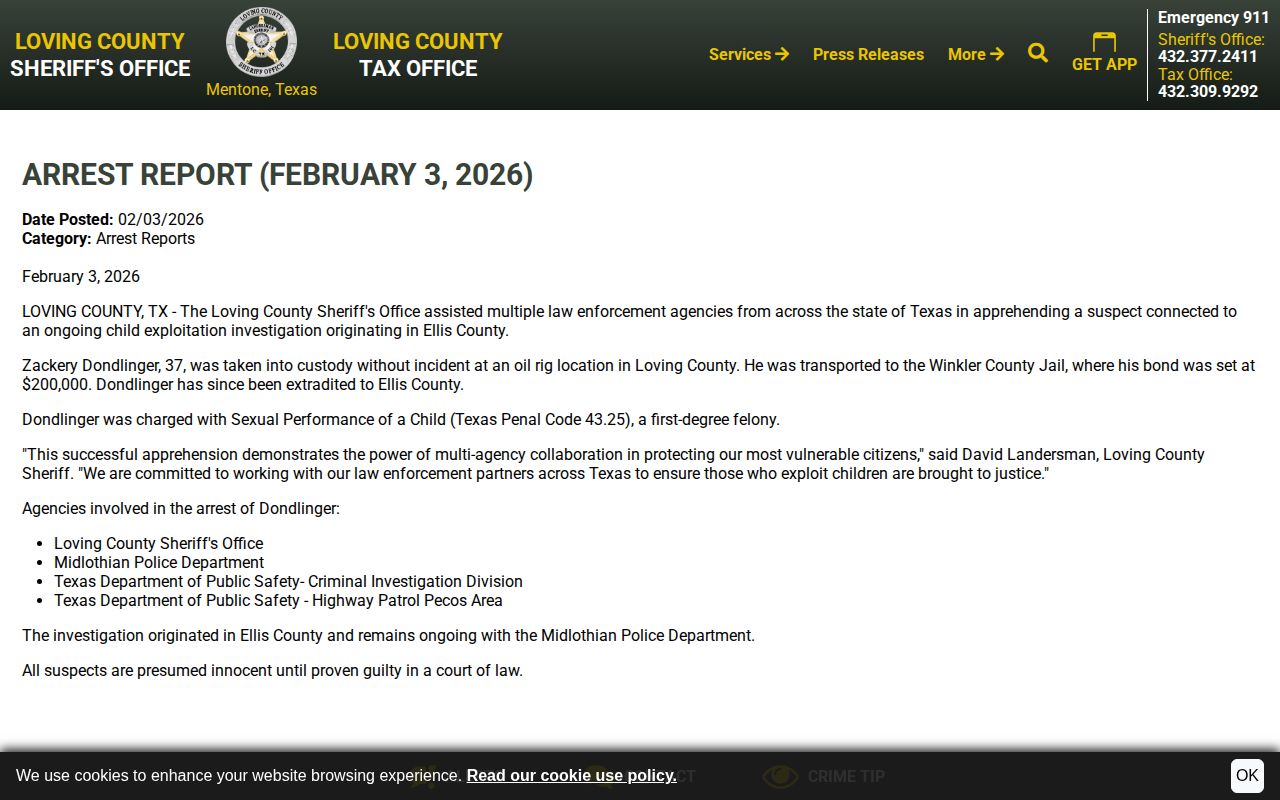
The image shows why a three-day review must include destination and receiving authority, not merely the date a person disappeared from one facility.
Interpret Loving County Release Results
Bond or personal bond can mean community departure while the criminal case continues. Time served, dismissal, and sentence discharge have different legal meanings. Parole or mandatory supervision ends prison custody but keeps the person under sentence supervision. Transfer, extradition, remand, and detainer pickup are not community releases.
A missing name may reflect spelling, booking lag, transfer, TDCJ commitment, federal or immigration pickup, or a service coverage gap. The safe result is a documented event: exact time, legal authority, type, and destination.
Request Loving Three-Day Release Records
Send Winkler a narrow request for the booking sheet, release order, exact timestamp, release type, destination, and property receipt. Include the full name, approximate arrest and release dates, Loving County as the origin, and booking or cause number if known. Ask for electronic copies and an advance cost estimate because no local flat fee was published.
Request the arrest or offense report from Loving only for material that agency maintains. Then ask the Loving County and District Clerk for the case disposition. The two records serve different roles and should not be forced into one custodian.
For an older three-day period, a live custody answer may have little value. Ask Winkler for the historical event, not whether the person is held now. The release order and exact time should be paired with the booking identifier. Seek the receiving authority whenever the record says transfer, extradition, remand, or detainer. A property-return receipt can support completion of a community release, while continued-custody paperwork points the other way.
The Loving court file may show a bond order, dismissal, plea, judgment, sentence, jail credit, capias, or revocation. It can explain the legal reason behind the jail event, but it is not a substitute for the physical release timestamp. Keep both records together and note any difference between the order date and the time Winkler finished processing.
Check the official Loving jail routing page, Winkler Sheriff page, and Loving records instructions for current access details.
Public Record Search
Sponsored Results