
Loving County Release Records
A Loving County arrest does not usually lead to confinement in a Loving County jail. The county sheriff performs law-enforcement work, but Loving County is listed as a closed-jail county that boards inmates elsewhere. The sheriff directs jail inquiries to the Winkler County Sheriff in Kermit. This makes the release trail a two-office record. Loving County may hold the arrest report, warrant or cause number, and official account of the arrest. Winkler County normally holds the booking, photograph, property record, release order, exact release time, and transfer destination.
“Released” means a person left one agency’s physical custody. It does not always mean freedom from every form of custody or control. Bond, dismissal, time served, or sentence discharge may return someone to the community. Extradition, transfer to the Texas Department of Criminal Justice, delivery to federal authorities, or an ICE transfer does not. Parole and mandatory supervision involve release from prison with rules and oversight. Probation, called community supervision in Texas law, generally allows a sentence to be served in the community under court conditions.
Loving County Release Types
The correct record source depends on the kind of departure. A county release record should name the event, while the court file explains the legal action behind it. State and federal systems use their own terms and keep separate records.
| Release or departure | Meaning and next source |
|---|---|
| Bond or personal bond | The person leaves county custody while the case continues. Check Winkler’s release time and the Loving court cause. |
| Time served or sentence discharge | The county sentence has been satisfied. Confirm the release order and final court disposition. |
| Dismissal or court-ordered release | A judicial order ends the stated basis for detention, subject to any other hold. Read the signed order and jail release entry. |
| Parole or mandatory supervision | The person leaves TDCJ custody under supervision. Use the TDCJ offender search and assigned parole office. |
| Transfer or extradition | Custody continues with another county, TDCJ, USMS, BOP, or ICE. Request the receiving authority and destination. |
| Flat discharge | The state sentence ends without parole supervision. TDCJ records may show the actual release or discharge date. |
- Detainer
- A request by another authority to hold or notify it about a person who might otherwise leave custody.
- Remand
- A court direction that sends or keeps a person in custody.
- Discharge
- The end of the sentence or custody term identified by the responsible agency.
- Time served
- Release because credited time already satisfies the imposed county sentence.
Loving County Release Record Fields
Texas jail standards require more than a simple “released” label. The releasing officer verifies identity and acts on an authorized release order. The facility keeps that order and the time of release. It also obtains a signed receipt for returned property. A focused request can therefore test the date, reason, destination, and handling of belongings rather than relying on a missing roster entry.
| Field | What it shows |
|---|---|
| Full name and booking number | Connects the request to the correct Winkler jail file. |
| Booking date and time | Marks entry into the jail phase after the Loving arrest. |
| Originating agency and cause | Links Winkler custody to Loving County’s report, warrant, or court case. |
| Charges and bond entry | Shows the recorded basis for custody and whether bond was posted. |
| Authorized release order | Identifies the authority permitting release or transfer. |
| Exact release date and time | Records when the person left Winkler’s control. |
| Release reason or type | Distinguishes bond, discharge, dismissal, transfer, and other outcomes. |
| Destination or receiving authority | Shows whether the person entered the community or stayed in custody elsewhere. |
| Property-return receipt | Documents the belongings returned and the recipient’s signed acknowledgment. |
An intake photograph and property inventory should exist under the jail standards, but existence does not guarantee unrestricted online access. Medical, juvenile, active-investigation, security, sealed, expunged, and other protected material can be withheld or redacted. Ask for nonexempt portions if a full record cannot be released.
Request Loving County Release Records
Send the request to the government body that maintains each part. Loving County calls its online route a “FOIA Request,” but Texas Government Code Chapter 552, the Texas Public Information Act, is the state process. Loving County should receive the request for arrest and offense material. Winkler County should receive the request for jail admission, booking image, release time, property receipt, and transfer details.
- Gather the full name, date of birth if permitted, approximate arrest date, and any warrant, cause, or booking number.
- Use the Loving Sheriff records-request instructions. Email sherifflandersman@co.loving.tx.us, cfielder@co.loving.tx.us, or lpearson@co.loving.tx.us, or mail P.O. Box 104, Mentone, TX 79754.
- Send a separate request to Winkler County Sheriff, 1300 South Bellaire Street, Kermit, TX 79745, or P.O. Box 860. The office number is 432-586-3461.
- Ask for existing records and exact fields. Request the release order, date and time, release reason, bond-posting entry, destination, booking photo, and property-return receipt.
- Request electronic copies and a cost estimate before charges exceed $25. The research identifies no fixed local copy fee or guaranteed response time, so do not assume either.
The Public Information Act does not require an office to create a new list, answer a legal question, analyze records, or provide future documents. A narrow request lowers uncertainty and cost. If the agency seeks an Attorney General ruling, follow the notice and stated deadlines. Court records go to the clerk because judicial records do not use the same Chapter 552 route.
The official request page can be reviewed before filing.
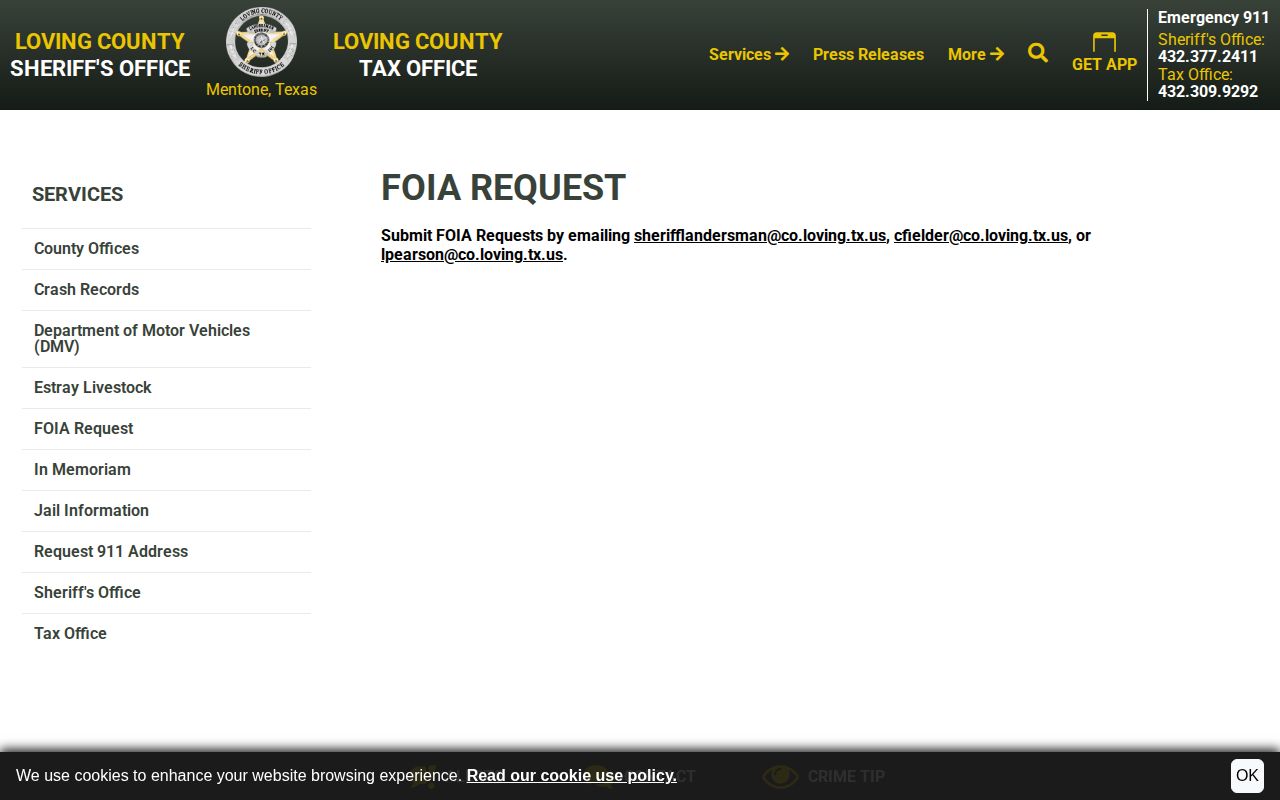
The screenshot identifies the local path for arrest-side records; Winkler must still be contacted for jail-created release details.
Loving County Release Record Law
Texas Government Code Chapter 552 governs public information kept by covered government bodies. The content controls, not whether the record is paper, email, or database data. Basic arrest and release facts may be available even if investigative detail is withheld. Request severable, nonexempt portions and ask the office to state the legal basis for any withholding.
Sealing and expungement can change access. Expungement is a court-ordered process that can require qualifying records to be destroyed or returned under the governing law. A sealed record remains restricted rather than functioning as an ordinary public release record. Juvenile information, private medical data, active-case details, and security information can also be protected. No specific Loving or Winkler retention term was found, so a request should not promise that an older release file still exists.
Texas Business & Commerce Code Chapter 109 provides a separate correction process for qualifying private businesses that publish criminal-record information. It requires review of a completeness or accuracy dispute and bars a correction or removal charge in covered cases. That process does not rewrite the sheriff’s or jail’s source record.
Loving County Release Times
Texas Commission on Jail Standards §267.6 sets the statewide operational floor. Sentence-discharge releases ordinarily occur between 6:00 a.m. and 5:00 p.m. A facility may credit up to 18 hours so the discharge occurs in that period on the prior day. Bond and specified warrant, transfer, or admission circumstances can produce an after-hours release.
Those rules are not a Winkler timetable. No official Winkler-specific release cadence, pickup window, or public exit location was found. A scheduled action may also be delayed by another hold or receiving agency. Call the jail before traveling and ask whether the release has been completed, not merely approved. The exact release-time record remains the best proof after the event.
Loving County Release Pickup
Getting home after a Loving County jail matter often begins in Kermit. The Loving Sheriff Jail Information page sends detention questions to Winkler County Sheriff at 1300 South Bellaire Street, not to the Mentone sheriff office. No official source identified a bus stop, family waiting area, property-pickup desk, rideshare policy, or transport route.
Families should call 432-586-3461 before travel. Confirm that all holds have cleared, the person has physically left custody, and staff can provide current pickup guidance. Administrative office hours are Monday through Friday, 8:00 a.m. to 5:00 p.m., but those hours should not be treated as a promise about release-desk operations.
The official routing notice shows why the physical release point matters.
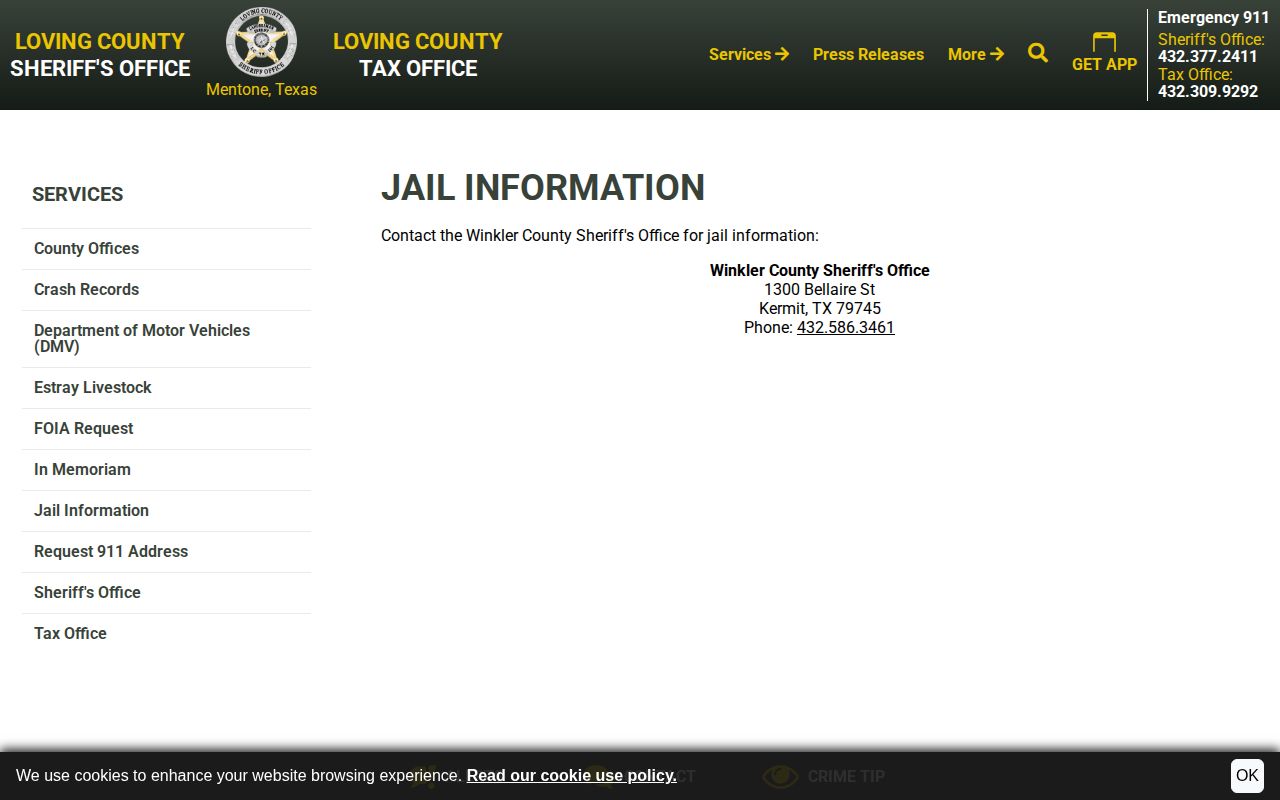
It directs a Loving County custody inquiry to the neighboring county that creates the jail release record.
Loving County Bond Releases
An official December 2025 sheriff report gives a local example. Several people were transported to Winkler and later described as out on bond. That statement is stronger evidence than disappearance from a current roster because it names a post-booking result. It remains an episodic press report, not a complete daily release list.
Bond release ends the immediate jail stay but does not end the criminal case. The Loving County court cause may continue with hearings, conditions, dismissal, plea, or judgment. Confirm the exact time through Winkler, then use the clerk’s record for the durable case outcome. The dedicated 24-Hour Releases page explains why no official same-day feed can replace those checks.
Loving County Release Property Records
Release verification can include personal property. Texas jail standards require a signed receipt when property is returned. The inmate-level record also includes intake, identification, property, continued-custody, release, and account material. A person disputing what was returned should request the Winkler inventory and signed return receipt by booking number and release date.
Copy Loving County on a related request only when its arrest-side material matters, such as property first taken by the arresting agency. Keep that issue separate from a private publisher’s inaccurate entry. Chapter 109 offers a no-fee correction path for covered private businesses, while the jail record must be challenged or clarified with its government custodian.
Loving County Release Feed Gap
Loving County publishes neither a 24-hour nor a 72-hour release feed. That absence is structural. The county jail is closed, local inmates are boarded with Winkler County, and the sheriff’s public site routes jail questions across the county line. Winkler’s official sheriff page also did not present a public recent-release list during the research sweep. There is no supported rolling window, update cadence, archive period, or set of public feed fields to quote.
A missing online entry cannot show what occurred. Start with a live Winkler custody inquiry, then request the exact release or transfer record. Pair it with the Loving court cause. That fallback is slower than a public list, but it yields the facts a list often omits, including the authorized order, exact time, release reason, and receiving authority.
Find Loving County Released Inmates
A complete Loving County released inmate search starts with the custody path, not a name-only web search. There is no official Loving 24-hour or 72-hour list. Winkler’s official page also did not show such a feed during the research sweep. Use the following order to tell community release from a move into continued custody.
- Check the Loving arrest or press record for the arrest date, originating charge, and transport clue.
- Call Winkler County Sheriff for current custody. If the person has left, request the release date, time, reason, and destination in writing.
- Search TDCJ if a felony sentence or state transfer is possible. An actual release date and parole-office status carry more weight than a projected date.
- Read the Loving County court disposition for bond, dismissal, judgment, sentence, or later case events.
- Use BOP for a federal sentence, the federal docket for USMS custody, or ICE ODLS only when the transfer record points to that system.
- Check the correct supervision source. TDCJ handles parole; the Reeves County CSCD grouping handles local probation questions.
Does “not found” prove release? No. It can reflect spelling, delayed data, transfer, a different system, or a sealed record. Get the destination field and court result.
Loving County TDCJ Release Search
The TDCJ Offender Search applies after a person enters Texas state custody. Search by name, seven-digit TDCJ number, or SID. The record may show identity, age, unit or parole office, status, offense, county and court, sentence, parole review information, Projected Release Date, and scheduled or actual release information.
| Search field | Use | Important limit |
|---|---|---|
| Last and first name | Broad search when no ID is known | Compare age and case details before deciding it is a match. |
| TDCJ number | Seven-digit state identifier | Useful only for a person already recorded by TDCJ. |
| SID | Texas state identification number | It differs from a county booking number. |
| Projected Release Date | TDCJ’s current calculated date | It may change and is not proof that release occurred. |
| Actual release and parole office | Evidence of prison departure and supervision | Parole means the person remains under TDCJ oversight. |
TDCJ’s free inmate-information email can provide listed basic facts such as location, conviction offense, incarceration history, county or court, and Projected Release Date. It does not provide photographs or Social Security numbers. Formal release certificates and discharge documents use the TDCJ Public Information Act process.
The official search screen illustrates the identifiers available to a Loving County release lookup.
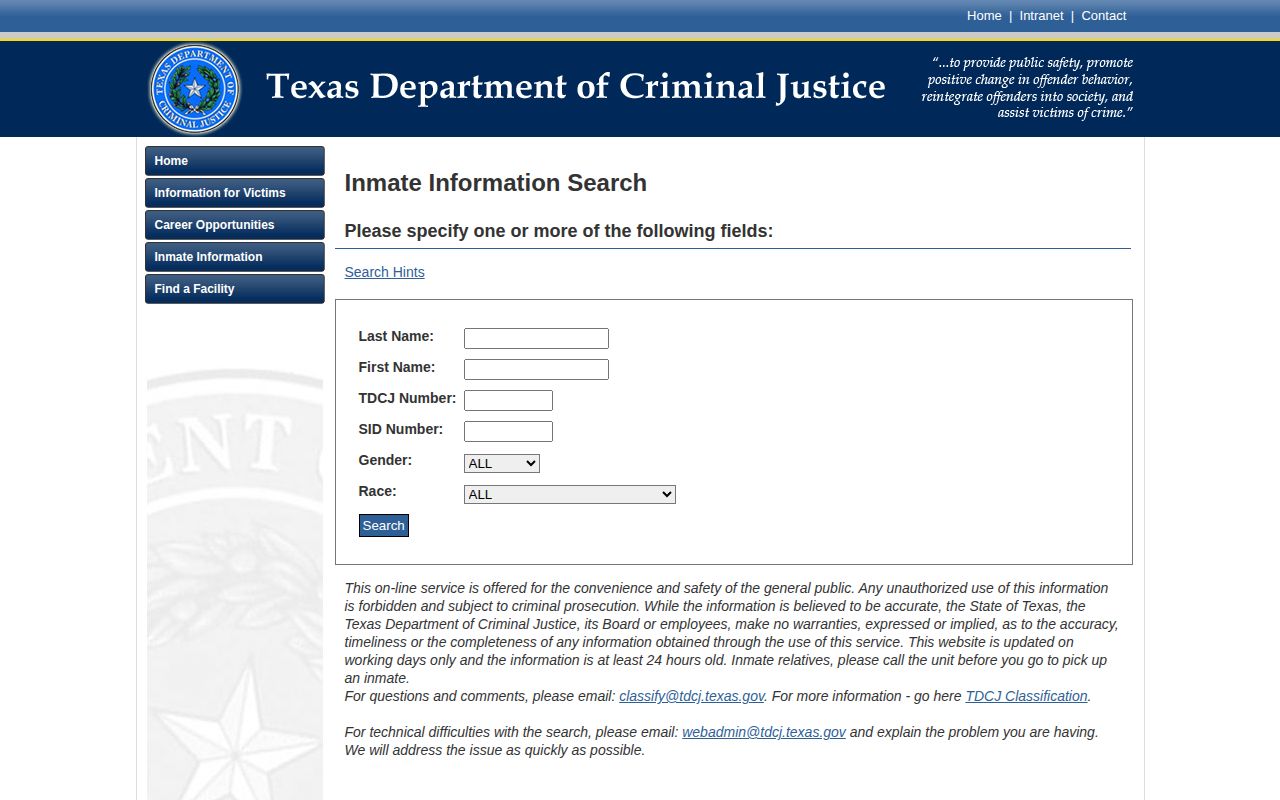
The result must be read for actual status and release details, not just a projected date. More date-field context appears under Release Date Lookup.
Loving County Release Court Records
The local court path is compact but split. Loving County Court meets on the second Wednesday and handles matters within its jurisdiction. The 143rd Judicial District handles district matters. The Loving County and District Clerk links to re:SearchTX for statewide court-record access.
A docket can explain why someone left custody. It may show bond, dismissal, a release order, judgment, or sentence. It does not prove the instant the jail carried out the order. Match the court action to Winkler’s exact release time and destination. This is also why a bond release should not be mistaken for a closed case.
The clerk’s official portal is the local starting point for that disposition search.
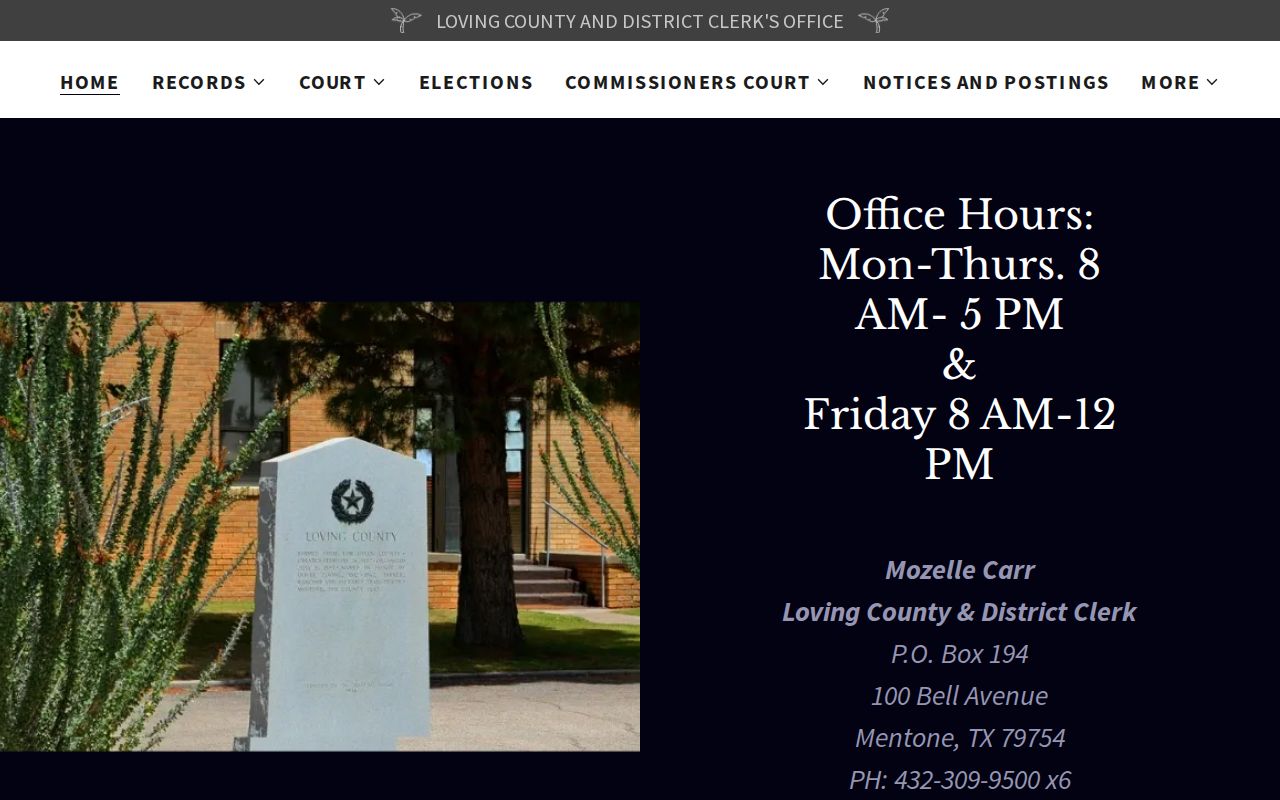
The court record explains the legal result, while the jail record supplies the physical release timestamp.
Loving County Release Supervision
Parole and probation are distinct. Parole is conditional release from a TDCJ sentence, decided by the Texas Board of Pardons and Paroles and supervised by the TDCJ Parole Division. Mandatory supervision is another supervised prison-release form governed by state eligibility rules. Probation, or community supervision, is ordered by a court and managed through a Community Supervision and Corrections Department.
The official community-supervision locator groups Loving, Reeves, and Ward through Reeves County CSCD. State parole uses a separate district-office network. An actual TDCJ result may list a parole office, but nearby Monahans or Odessa offices should not be assumed without confirmation. Use Post-Release Supervision for the correct parole and probation channels.
Loving County Release Notifications
Texas replaced county VINE/VINELink with Texas IVSS-Counties on September 1, 2025. Current county notification instructions should use the new account-based system, not old four-digit-PIN directions. TDCJ operates a separate IVSS for state-prison and parole events. These systems deliver status notices, but a notice should still be checked against the jail, TDCJ, or court source that created the event.
Federal paths are system-specific. The BOP locator covers federal BOP custody from 1982 to the present and can show “Released” or “Not in BOP Custody,” a release date, and no current institution. That does not rule out another agency’s custody or federal supervised release. USMS has no public released-detainee locator, so use the federal docket and a records request. ICE ODLS is relevant only when the county transfer record points to immigration custody. A not-found ICE result is inconclusive. The VINE Inmate Check page explains the current Texas notification split.
Loving County Release Transfers
A February 2026 Loving Sheriff report documents why destination matters. A person transported to Winkler was later extradited to Ellis County. The person left Winkler’s facility but remained in custody. This is not a theoretical warning; it is a local example of a roster disappearance that was not community release.
Always request the receiving authority and destination. If the destination is another county, contact that jail. For TDCJ, use the state offender search. A federal transfer may require the federal docket, USMS records, or BOP locator. Use ICE ODLS and its Detention Reporting and Information Line only when an immigration handoff is supported. Never infer ICE custody from a routine Loving arrest.
Loving County Release Lookup Sources
Each system answers one part of the release question. Choose it from the custody stage and confirm important results with the maintaining office.
| System | Best use | What it cannot prove alone |
|---|---|---|
| Winkler custody inquiry | Whether a Loving arrestee is still held now | A missing name does not state the release reason or destination. |
| Winkler release record | Exact time, authorization, reason, and transfer destination | It does not provide the full Loving court outcome. |
| Loving court record | Bond, dismissal, judgment, sentence, and legal disposition | A docket is not the physical jail exit time. |
| TDCJ offender search | State custody, projected or actual release, and parole office | It does not cover a person who only had county jail custody. |
| BOP locator or federal docket | Federal sentence status or federal release order | BOP release does not exclude other custody or supervision. |
| ICE ODLS | Follow-up on a documented immigration transfer | A not-found result is not proof of community release. |
Loving County Release Facilities
The facility map includes every custody system that may matter after a Loving County arrest. Only Winkler is the routine county holding and physical release point. The Loving Sheriff is the originating agency, not an operating jail. State and federal entries apply only when the case moves into those systems.
- Winkler County jail/detention operation: county booking, property, exact release time, bond release, and transfer records.
- Loving County Sheriff's Office: arrest and offense records, warrants, cause identifiers, and official press accounts.
- Texas Department of Criminal Justice correctional institutions: state sentence, prison location, projected or actual release, and parole status.
- Federal Bureau of Prisons facilities: federal sentenced custody and BOP release status.
- U.S. Marshals Service, Western District of Texas: federal pretrial custody, transport, and commitment path.
- ICE detention system: case-specific follow-up after a documented immigration transfer.
No official source identified an open Loving jail, municipal lockup, TDCJ unit, BOP prison, or ICE detention center physically in the county. That bounded finding does not rule out brief law-enforcement holding. It does prevent the Mentone sheriff office at 114 West Collins Street from being misidentified as a public jail release desk.